






















The special education classrooms, located at the end of the 2000s hallway, are places where students can receive the extra help they need.
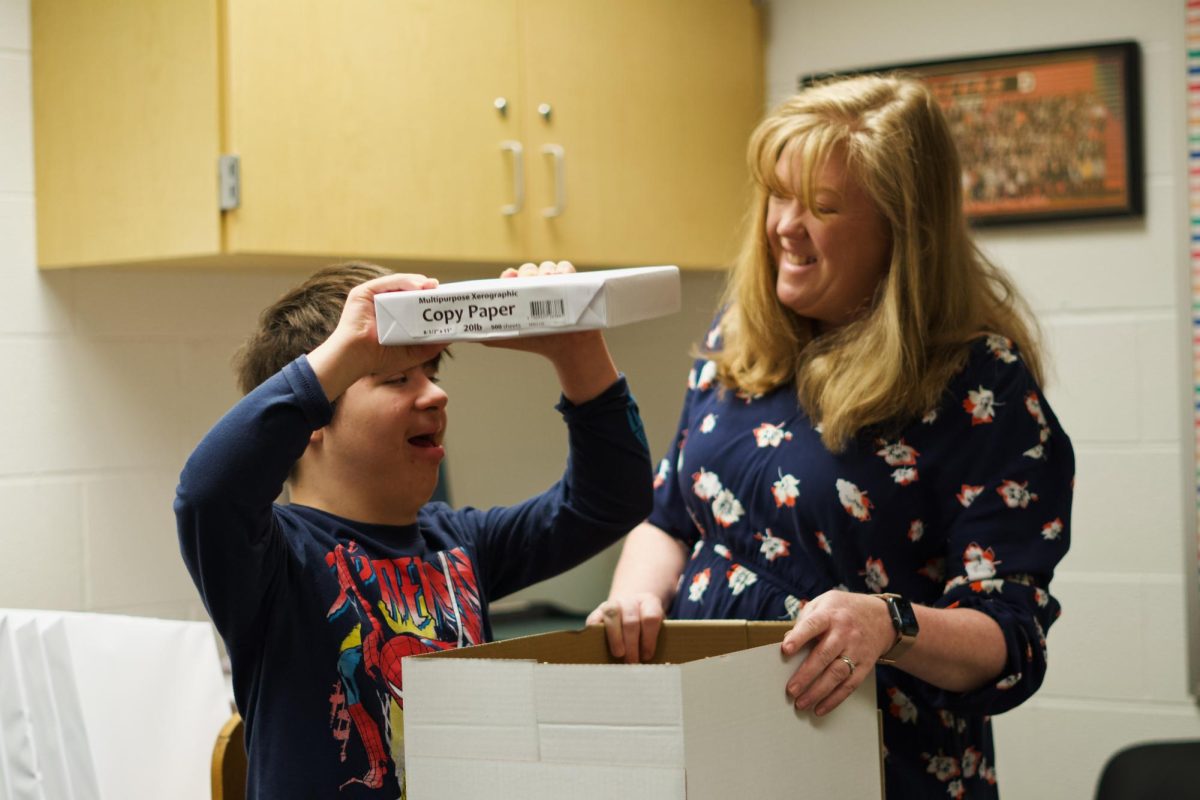
There, the staff work to create an environment that fits for their students, since traditional public school methods are not applicable. Instead of handing out worksheets and giving lectures, the staff focus on the individual students’ needs. This can be reading to students, making a recipe with them, or following News to You, a weekly packet with a story, questions and more.
“I look at what typical high schoolers do, and then I try to figure out a way that we can present that information in a way for them that’s meaningful, that will help make their life richer and fuller,” award-winning intervention specialist Becky Saunders said.
Paraprofessional Gwendolyn Steger-Montgomery, who works in the same classroom as Saunders, agrees.
“Each student definitely has individual needs so you learn to adapt to what makes them happy, and I think that’s what’s most important,” Steger-Montgomery said.
Working with students who have special needs comes with more than just teaching. The staff work closely with families, making sure there is clear communication. Each day, the staff fill out home notes to keep families up-to-date on how their kids are doing.
This is especially important for those who have medical complexities, which can be stressful for families.
“Being able to support families, and being able to be a person and a place where my families can know that their kids are well taken care of, and their kids are loved and learning and growing, is really what I like the most,” Saunders said.
Saunders lives in Delaware, so she sometimes sees families from her classroom outside of school. She said there have been a few times when she is shopping for groceries and parents she knows will come up and thank her.
“I just really get to know the families in a way that is really special, and it doesn’t always happen,” she said. “I mean, if you’re playing a sport, you know the same coach for four years or something like that, but the relationships that we’re able to form with our families is really special and really cool.”
This school year, a parent of a past student texted Saunders and asked if she would be willing to facetime. The student, who is now in his mid-20s and living with his parents due to significant autism, was having a bad day and wanted to say hi. The happy memories and familiarity of his past classroom still stuck with him.
Besides working within their classrooms, the special needs staff also go out of their way to aid the whole student body. They run several resources for the Hayes community including the free store, grocery store, office supply store and a locker that is stocked with snacks. Soon, they hope to open a hair salon where students can go to get their hair cut for free.
Their goal is to see what Delaware offers and bring it to the school.
Senior Caleb Hershberger said he first learned about the free store when he saw a chalkboard sign advertising it by the Pacer doors in the back of the school. However, he thinks there should be more promotion for the resources provided at Hayes.
“I feel like it could be something that is very important, especially because there are people that I’ve seen [who use] a free lunch program and stuff like that, [and this is] sort of like the same thing,” Hershberger said. “[The issue is] the bad advertising, because literally something like a free store is a good way for people who may not have the means to get stuff to get access to stuff.”
Unlike the free store, other resources provided by the special education staff have been advertised throughout the school. For example, the snack locker was mentioned in one of the issues of “Privy Thoughts,” the monthly poster the library staff puts up in the restrooms.
The extra work that the special education teachers put in shows throughout Hayes and their dedication comes from a love for their job.
“I love the people that I work with, they’re all amazing. I love the kids and I love my job; I enjoy coming to work everyday,” Steger-Montgomery said.