























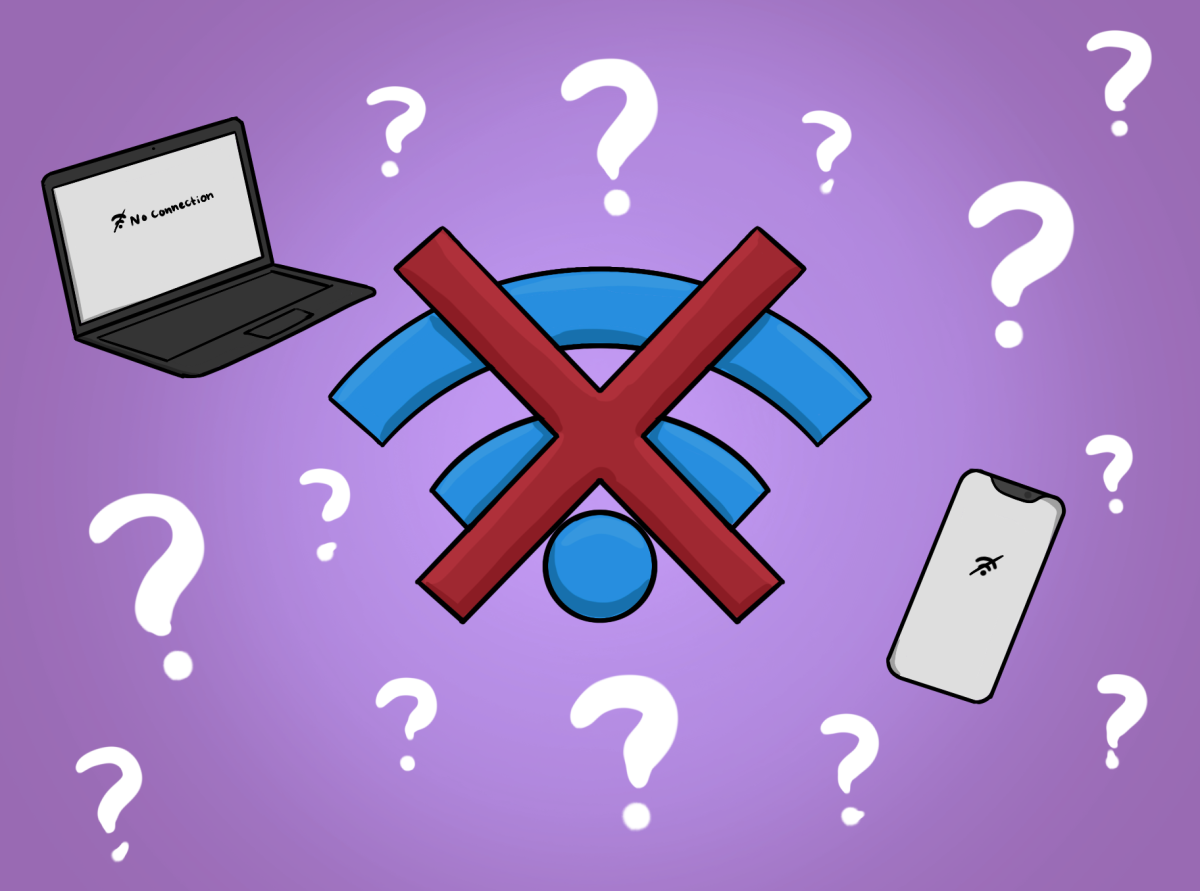
As the year progresses, a recurring issue that staff and students have noticed is the frequent network outages. In one moment, everything works as it should, and in the next, all technology use is suspended until the internet comes back up. The outages are random, taking everyone by surprise.
Last year, new network equipment was installed and since then, updates to that equipment have caused the outages the school experiences. In response, the district has been working with its vendors to restore the network each time it goes out. Though, the outages still continue, despite their efforts.
The outages affect each class differently. Classes that don’t rely on the internet are less affected, while the classes that do use the internet are majorly affected to the point of cancelling and completely changing lesson plans.
Math classes are among those that aren’t affected as badly by the outages. The paper-based learning is the main cause of that. But, it isn’t fair to say they are entirely unaffected.
“There are things we use the internet for like level one testing on Delta, any Delta practices, [and] obviously Canvas that we don’t have access to when [it] is out,” algebra teacher Colin Madigan said.
Though the outages may be an annoyance to math teachers, they have still developed ways to work around it.
“Sometimes [the] students won’t have internet [but] I’ll have internet so if that’s the case, then I can print off a level one and try to run copies real quick,” Madigan said. “There’s other times where if we’re doing a lesson or practice and we don’t have internet, I’ll just come up with problems on the fly and we’ll make a game out of it.”
As for English classes, issues with the internet have a more significant impact. Ranging from AP Literature to sophomore English classes, all are affected by the outages in various ways.
“[With] AP Lit specifically, [the outages] set us back six days in the curriculum,” English teacher Kelsey Wright said, “so, we had to keep switching what we were doing.”
However, the underclassmen classes have been able to adapt better than the upperclassmen classes. The normal English classes are used to using paper often and tend to be rather flexible since they don’t often rely on the internet.
“My sophomores were a lot less affected, but it just made class a lot less interactive than it could have been because we couldn’t access the materials we [wanted] for over a week,” Wright said.
To adapt, the English teachers have been utilizing some less commonly used tools.
“I have done a lot more with whiteboards and I’ve learned how to use powerpoint instead of relying on google slides,” Wright said.
Science and history classes are also having their fair share of difficulties as well.
“A lot of times I am able to easily switch what we’re doing to paper either by using my camera to project something or just write on the whiteboard,” physical science and chemistry teacher McKenna Shireman said.
Similarly, history classes are mostly paper based, so they aren’t majorly affected. However, this year the freshman history classes have been working with online textbooks so when the internet goes out, they are unable to access the information they need.
Despite the struggles, the teachers have been working hard to ensure their students still receive their education and stay on track.
“[I] could still stream from [my] computer to [the] TV so [I] could alter and throw something up there for [the students] to look at instead,” history teacher Nathan Weakland said. “[I] had to pivot and find a way to keep [the students] entertained and learning without use of technology.”
Some teachers have even been able to find a little light in the situation.
“Because the internet has been in and out so much, I’m not having students solely on their chromebooks as much,” Shireman said.
One plus of the internet going out is that students might pay more attention to what the teachers are saying, rather than having the distraction of a computer.
However, the majority of the school’s population is still annoyed at the outages. The network outages come without warning and force teachers to adapt fast and change their plans.
“What’s most frustrating about it is that you don’t know you need to make changes until you show up in the morning,” French teacher Kimberly Young said. “For some people, you show up at 7:00 a.m. and you have class at 7:25 a.m. and [then] all the sudden, you need a brand new lesson plan.”
No matter which teacher or which subject they teach, everyone is inconvenienced in some way. Still, the outages are no one person’s fault. In fact, the technology staff has been working tirelessly to fix the issue as soon as possible.
“We have a new piece of equipment that arrived in the district and it is going to be getting installed over winter break. When we have that installation, that’s going to help us stabilize the network further,” Chief Technology Officer Jennifier Fry said.
The installation will initially cause a major outage, so that is why it will happen over winter when no one will be affected by it. When students and staff return from break, Fry said the network will be up and running better than ever for everyone.
“It’s the top priority that we have access [to the internet] for our students and staff,” Fry said.