
























As the month of March progresses, so do the plans for the Artemis II mission. After Artemis I in 2022, NASA decided to build off its success with Artemis II this year. Artemis II will be NASA’s first crewed lunar flyby in roughly 50 years.
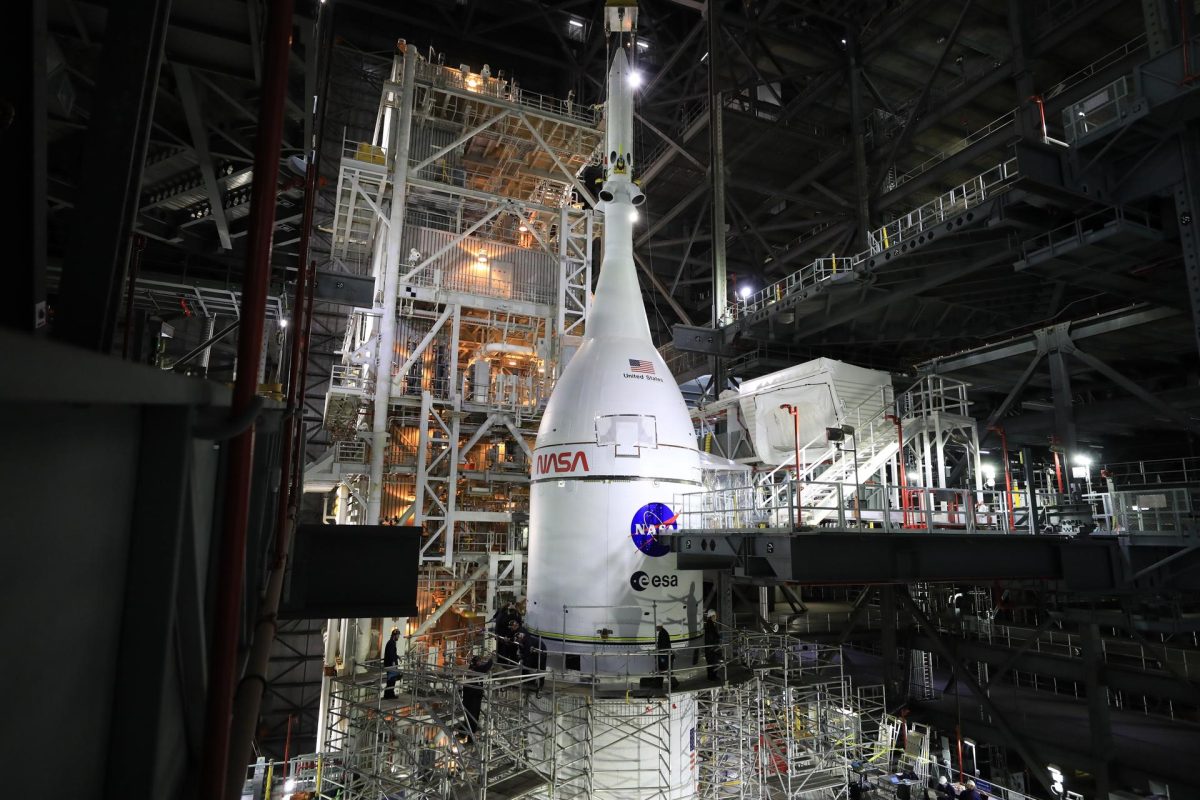
As of this past month, NASA has been testing out the Orion spacecraft, the designated Artemis II spacecraft, to ensure it is both prepared for the journey ahead and capable of protecting the four crew members that will be on board. It will be launched from the SLS (Space Launch System) when the mission is ready to be put into action.
On Feb. 21, a wet dress rehearsal took place involving the inspection of the rocket, specifically the vehicle’s stage adaptor.
The mission, which does not yet have a set date, is expected to launch sometime in April of 2026. The group of four astronauts that will man the Orion Spacecraft will be in space for ten days before returning to Earth. This will test NASA’s deep space capabilities and pave the way for the future Artemis III mission by testing a sling-shot method.
The mission’s method is to have a ship fly around the Moon and use the momentum gained from that, along with Earth’s gravitational pull, to effectively “sling-shot” back to Earth without using up much fuel. If this method ends up proving to be a success, it could greatly improve space travel and how far humans can explore.
“[I am hoping] the sling-shot [method] is going to be successful,” former adviser of the Hayes NASA ACD team Joanne Meyer said. “There’s so much to be explored. I think [this is] going to be huge.”
The crew, consisting of Reid Wiseman, Victor Glover, Christina Koch, and Jeremy Hansen, features each member bringing different talents and specialties to the mission.
Wiseman is the commander of the mission crew. He was selected to be an astronaut in 2009, and served as a Flight Engineer aboard the International Space Station for Expedition 41 in 2014.
The pilot of the crew is Glover. He was selected to be an astronaut in 2013 and served as the pilot of the SpaceX Crew-1 mission to the international space station.
Koch is one of the two mission specialists in the crew. Similarly to Glover, she was also selected to be an astronaut in 2013 and she recently served as a flight engineer on the International Space Station as a part of expeditions 59, 60 and 61.
Last, the second mission specialist of the team is Hanson. He graduated from Astronaut Candidate Training in 2011 and has since participated in a few Earth-based missions ranging from living underground to exploring the ocean floor.
Those interested in space exploration and NASA itself all have high hopes for the success of the mission and what it will accomplish for the future missions. The mission’s goals will test how far modern-day space technology has come and NASA adaptability to the unknown.
“Right now we have a lot of hypotheticals and mathematically [the numbers] make sense,” Earth and Space Science teacher Garrett Eiben said, “but space is a [totally] different thing. I really hope that it takes us a step forward in space travel.”
Fans can look for the official launch of the Artemis spacecraft on the NASA app or YouTube and follow the crew while they are in space with AROW on the NASA website so they don’t miss this controversial point in space history.
“[All of my classes]—we are all going to be watching it whenever it finally flies,” Meyer said.