

















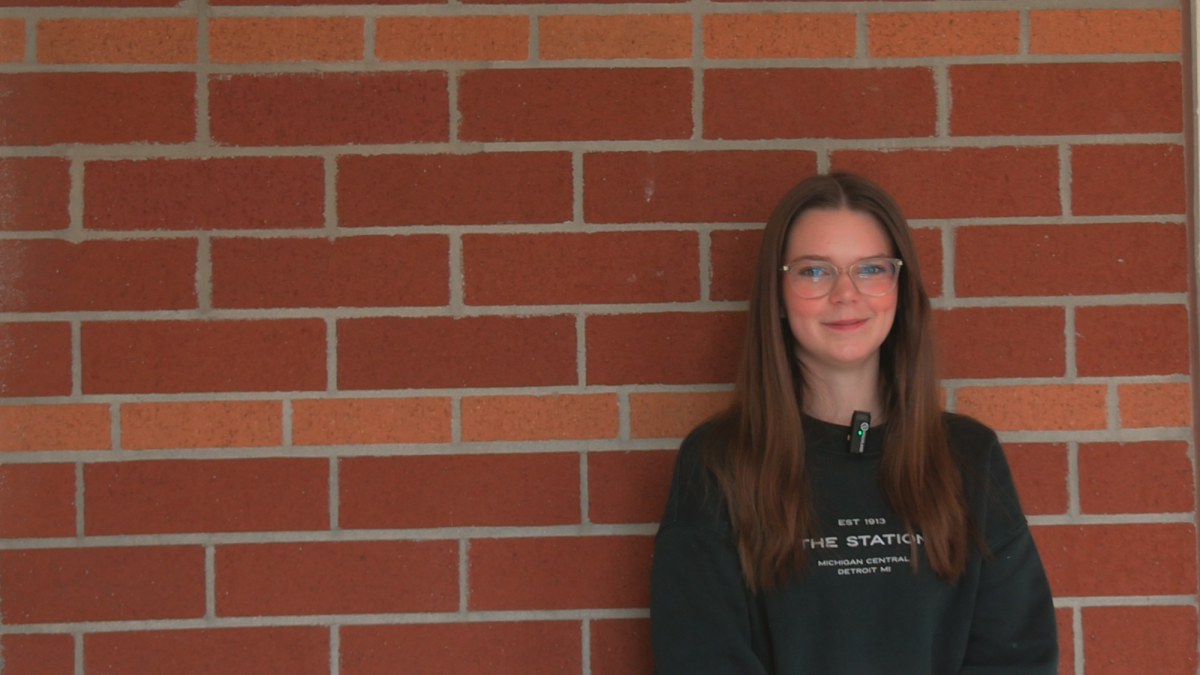



As fall sports come to a close, junior Cate Artemus is advocating for an automated external defibrillator to be placed on the Hayes track for the safety of stadium users.
An automated external defibrillator, or an AED, is a life-saving device that uses an electric shock to revive someone that is experiencing sudden cardiac arrest.
Currently, there are three AEDs scattered across Hayes in case of an emergency: the 2000s hallway, the cafeteria, and the art hallway. In addition to those three, athletics has six portable AEDs, one being on the home side of the stadium.
“It’s important to have them scattered, so that one is close,” principal Jake Shafer said. “But also so that there’s a better chance that someone sees where it is.”
Though the stadium and the track are in close proximity to each other, the AED on the home side is typically locked away in the concessions, meaning accessibility for this device on the track is difficult to obtain unless there is a coach, trainer, or staff member nearby.
Therefore, Artemus is working to write a grant to place an AED on the away side of the track for the safety of students, athletes, and other members of the community.
“I am a huge safety advocate,” Artemus said. “I think that they are often overlooked when there is so much an AED can do for some people.”
As of now, in the event of an emergency on the track, the closest AED would be in the concessions or on a trainer. However, Artemus’s biggest concern is the lack of accessibility when a trainer is not present.
“When I asked about [AEDs], I was met with a response that there was always a trainer out there,” Artemus said. “[But] there’s not always a trainer out there.”
The Hayes track and stadium is used by many members of Delaware, whether there is a sporting event taking place or just for personal reasons.
“The stadium is used by a lot of people,” athletic director Steve Glesenkamp said. “[Another AED] would be something that would be available to the community, if you will.”
With these concerns, Artemus has created a plan that takes major steps towards funding another AED for the school and educating others about the device.
Since AEDs are such powerful and necessary tools, they are costly. In order to purchase another, Artemus is working with Shafer to write a grant.
“What we are trying to do is get grant funding through the state of Ohio to install an AED,” Shafer said. “They would provide us with equipment, and then we would just be in charge of installing and servicing that.”
Artemus and Shafer plan to work with programs like the athletic boosters for the grant to enhance connections and receive sponsorships.
“The athletic boosters are a byproduct of the athletic department,” Glesenkamp said. “They provide extra money for things.”
The grant will be written, sent, and reviewed by the state in December.
Alongside funding, Artemus has made it one of her goals to educate her fellow classmates, staff members, and people in Delaware.
“I am working with the Maker Space to create stickers,” Artemus said. “Then hopefully in the near future, some signage to go up in our buildings.”
Artemus plans to extend this project outside of Hayes and to other buildings in the district.
“I have reached out to all of our principals, at all of our buildings [with hopes] to collaborate with them [and] to let them know what my plan is,” Artemus said.
In addition to stickers and signage, Artemus plans to work with the student advisory board to create a video or presentation to show to students during House period to illustrate the importance of learning how to use an AED.
“[Cate’s] passionate about this project, not because it benefits her in any way,” Shafer said. “She just wants to do the right thing for the community and I completely agree with seeing the need.”
Overall, Artemus is fighting for the safety of students, athletes, and more importantly, the community of Delaware. Educating and capturing a new location for the AED can save the life of someone who does not know it.
“It’s incredibly important to educate yourself when you walk into a building and know where and what keeps students safe,” Artemus said.